 Hyperliquid crypto
 trading ties balance checks to order outcomes
Hyperliquid crypto trading starts with a usable HyperCore balance, a selected spot or perpetual market and an order matching the intended execution. Spot trades change asset balances, while perpetual trades change a collateralized position and its margin exposure. The onchain order book decides whether an instruction fills, rests or cancels under its price and time-in-force settings. After submission, the reliable evidence is a fill record plus a changed balance or position, not the presence of a signed request. Open orders remain separate until they match or are canceled. Account readiness comes first, followed by order selection and result verification.
Balances, margin mode and order instructions determine whether an order fills, rests, cancels or is rejected and how any fill changes the account.
From compatible funds to an account result
A usable trading balance must exist in the correct account state before an order can change a position or spot holding.
Hyperliquid is an L1 blockchain whose execution includes HyperCore and HyperEVM. Trading through the onchain spot and perpetual order books occurs in HyperCore. HyperEVM supports smart-contract transactions, but an asset located there is not automatically available as a HyperCore trading balance. A deposit or transfer must use a supported asset, destination and network combination. An unsupported route can leave the intended trading account uncredited.
Connecting a wallet may require account access or a signature. It should never require disclosing a private key or recovery phrase.
Once the balance appears, the selected market determines the next state. A spot buy exchanges quote balance for the traded asset. A perpetual order instead opens, increases, reduces or closes a position against collateral. Price, size, direction, margin mode and order options must describe the same intended action. The observable outcome is then a fill, a resting order, a cancellation or a rejection with no trade.
Which order instruction matches the intended execution?
A market order favors immediate execution, while a limit order favors a stated price boundary.
Neither choice guarantees a complete fill at one price. Available depth determines how much can trade, and time-in-force controls what happens to any unmatched quantity. Conditional orders add a trigger before the book receives the executable instruction. Reduce-only settings apply another boundary by preventing an order from increasing a perpetual position.
Execution controls attached to an order
- A market order trades against compatible resting liquidity available at submission.
- A limit order trades only at its limit price or a better price.
- Good Til Cancel keeps unmatched size open until it fills or receives a cancellation.
- Post-only requires the order to rest instead of immediately taking liquidity.
- Immediate or Cancel fills available size at once and cancels the remainder.
A capped Immediate or Cancel spot order
All balances, prices, quantities, book depth and outcomes in this example are hypothetical. The account has 836 quote-asset units, and the intended purchase is eight units of a selected spot asset. The displayed best offer is 52.24, while the highest acceptable price is 52.26. Assume the price and size satisfy the market’s live tick size, lot size and minimum order value.
Immediate or Cancel limit buy at 52.26
An Immediate or Cancel limit buy at 52.26 can execute only at that price or lower. A market order instead prioritizes immediate execution and does not promise one fill price. The limit action therefore preserves the stated price boundary.
Full fill or partial fill with cancellation
If eight units are available at 52.24, the fill has a gross notional of 417.92 quote units before fees. The balances then reflect the eight-unit fill and the charged fee. If only five units are available within the cap, five fill and the remaining three cancel. The account then shows the corresponding balance changes and no resting remainder.
Margin choices set the liquidation boundary
Higher selected leverage reduces the initial margin required for a given perpetual notional. It does not remove maintenance requirements or liquidation risk.
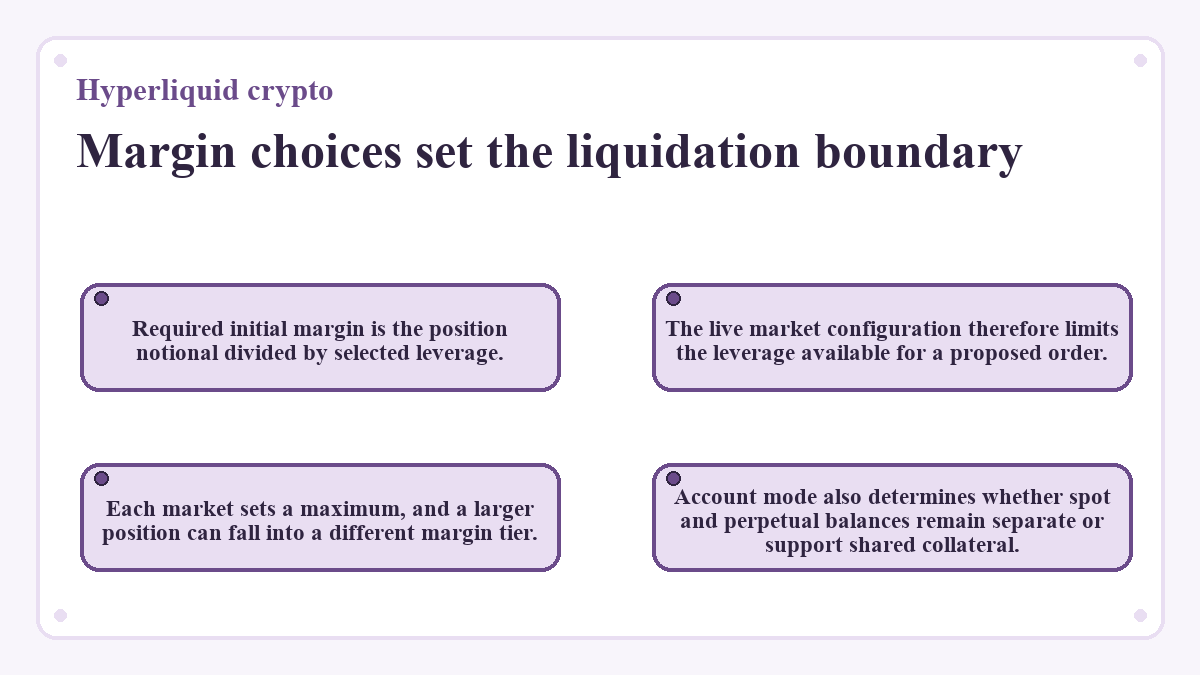
Required initial margin is the position notional divided by selected leverage. Each market sets a maximum, and a larger position can fall into a different margin tier. The live market configuration therefore limits the leverage available for a proposed order. Account mode also determines whether spot and perpetual balances remain separate or support shared collateral.
Cross margin
Cross margin shares collateral among cross-margin positions in the relevant account. Profit or loss in one position can change the margin available to another. A severe loss can expose the shared balance and other cross positions to liquidation.
Isolated margin
Isolated margin confines assigned collateral to one position. Liquidation of that position does not affect separate isolated positions or the cross-margin account. Adding or removing isolated margin changes its liquidation boundary. Some markets permit only isolated margin, so the market configuration can remove this choice entirely.
What does the order book confirm before submission?
The book shows executable price levels, available size, spread and depth for the selected market. These fields reveal whether the proposed quantity can trade near the displayed best price or must reach deeper levels. They do not promise the same state will remain when the signed order arrives.
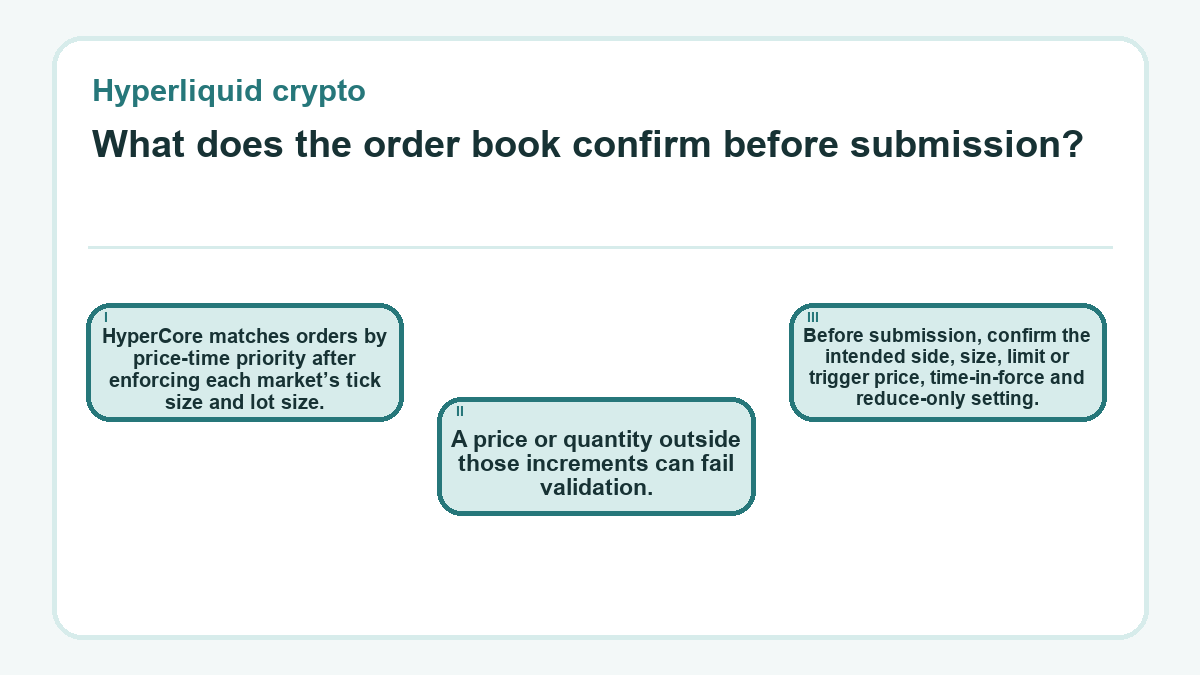
HyperCore matches orders by price-time priority after enforcing each market’s tick size and lot size. A price or quantity outside those increments can fail validation. Before submission, confirm the intended side, size, limit or trigger price, time-in-force and reduce-only setting.
Perpetual orders face an additional margin check. A resting order receives another check when matching, so a later collateral shortfall can cancel it even though placement initially succeeded. Reviewing an open-order entry without checking fills and positions can therefore give an incomplete account picture.
Costs appear during execution and while positions remain open
Trading fees depend on the fill rather than the requested order size. The fee schedule distinguishes spot and perpetual activity, while an account’s tier uses rolling 14-day weighted volume. Maker and taker treatment depends on whether the order adds resting liquidity or removes it.
Slippage is separate from the posted trading fee. A marketable order can consume several price levels when its size exceeds liquidity near the best quote. A limit price bounds execution price, although that protection may leave part or all of the order unfilled.
Perpetual positions also exchange funding between long and short holders. A positive rate transfers funding from longs to shorts, while a negative rate reverses that direction. Settlement occurs hourly and can change account equity after entry. Spot holdings do not incur perpetual funding.
Deposits, withdrawals and transfers are separate account actions and may carry network or protocol costs. Those amounts should not be folded into the trade’s execution price when comparing a fill with the submitted order.
How do you verify the resulting account state?
A completed trade appears as a fill and a corresponding change in balances or position state.
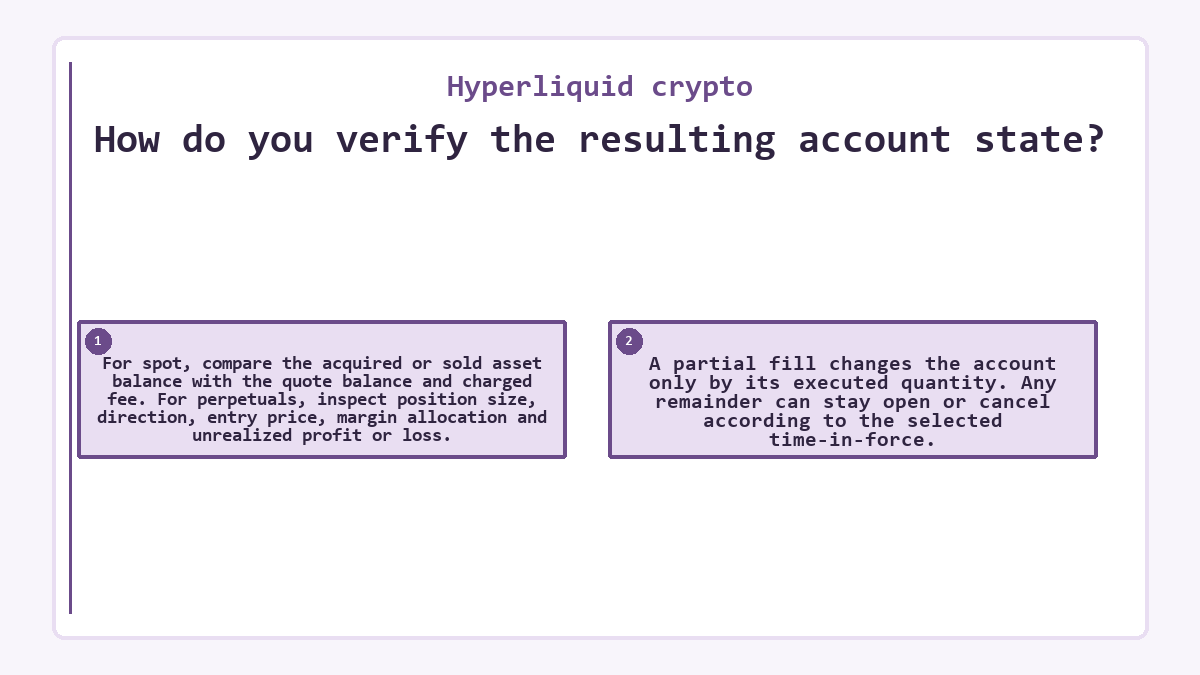
For spot, compare the acquired or sold asset balance with the quote balance and charged fee. For perpetuals, inspect position size, direction, entry price, margin allocation and unrealized profit or loss. A partial fill changes the account only by its executed quantity. Any remainder can stay open or cancel according to the selected time-in-force.
Order status supplies the missing context. Open means unmatched size remains on the book. Filled means the stated quantity executed, while canceled or rejected means some or all of it did not. Entry price and displayed profit or loss help interpret the position, but balances, margin and recorded trades form the underlying account state.
Exits, cancellations and the HyperCore boundary
Canceling an order removes only its unfilled remainder. It cannot reverse quantity already executed. Closing spot exposure requires a matching sale, while a perpetual exit uses an opposing order. A reduce-only instruction prevents that exit from opening a position in the other direction if the existing position has already shrunk or closed.
Liquidation creates a different exit path. When account equity falls below the applicable maintenance requirement, the system can send closing orders to the book. Cross and isolated positions use their respective collateral boundaries, so the same price move can affect their surrounding account state differently.
Transfers between HyperCore and HyperEVM do not replace trade verification. The destination balance must change before the asset can serve its intended role. For example, HYPE held on HyperEVM pays EVM gas, while a HyperCore order changes the relevant trading account.
Hyperliquid crypto: frequently asked questions
Why might a reduce-only order be rejected?
A reduce-only order is rejected or canceled when it would increase exposure rather than reduce the existing position. This can happen after another order closes the position, when the order side is wrong or when the remaining reducible size is smaller than requested. The live position size determines how much the instruction can still reduce.
Which price activates take-profit and stop-loss orders?
The mark price activates take-profit and stop-loss orders on Hyperliquid. Triggering does not establish the eventual trade price. A market variant then seeks immediate execution, while a limit variant enters the order book at its specified limit. Fast movement or limited depth can make the execution price differ from the trigger.
Can a stop-limit order remain unfilled after it triggers?
Yes, a stop-limit order can remain unfilled after its trigger condition is met. Triggering places its limit order on the book, but it does not create compatible liquidity. If the market moves beyond the limit, the order may rest without filling. The account remains exposed until another order actually reduces the position.
Why can the liquidation price move after a perpetual position opens?
The displayed liquidation price reflects changing account state rather than a fixed promise. Funding payments, unrealized profit or loss and changes in other cross-margin positions can alter available margin after entry. Isolated margin narrows the inputs to its assigned collateral and position, but adding or removing that margin also moves the estimate. Margin tiers can matter for larger positions.
When does a HyperCore order require network gas?
Orders submitted directly to HyperCore do not require a per-order network gas payment. A wallet may still need to sign the trading authorization or order. An order sent through HyperEVM’s CoreWriter uses HYPE for the EVM transaction, and moving funds into the system can require gas on the sending network. These costs are separate from maker, taker and funding charges.
What causes a post-only order to be rejected?
A post-only order is rejected when its price would immediately trade against resting liquidity. The instruction exists to add liquidity, so a marketable price conflicts with it. Moving the limit away from the opposing best price may let it rest, although the book can change between review and submission. A later match can fill it as maker liquidity.
Can sub-accounts receive a separate fee tier from the master account?
Sub-accounts do not receive independent fee tiers. Their trading volume counts toward the master account and all linked sub-accounts share its tier. Referral discounts do not apply to sub-accounts, so the effective fee can still differ from the master account despite the common tier. Vault activity follows separate volume treatment.
What can reject an order before it matches?
An order can fail validation when its price violates tick size, its value falls below the market minimum or its payload is invalid. Perpetual orders can also fail for insufficient margin, position limits or open-interest controls. A valid format still does not guarantee matching because the book may lack compatible liquidity. The returned status distinguishes rejection from later cancellation.
Updated on